JINPAT Slip Rings: Providing flexible engineering solutions for industrial robots.
In the field of industrial robotics, the flexible movement of joints is crucial. To provide stable power supply and signal control to end effectors (such as welding guns, grippers, and cameras) while enabling continuous, unlimited rotation and preventing cable entanglement, slip rings are indispensable core transmission components. JINPAT LPT series hollow shaft conductive slip rings, with their superior design and reliable performance, are an ideal choice for many industrial robot applications.
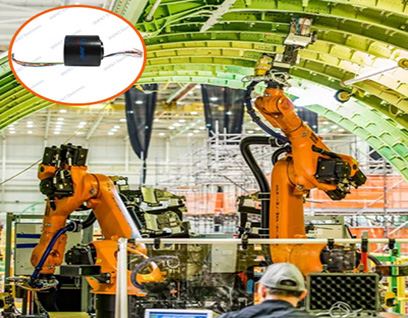
The JINPAT LPT series 38mm through-hole slip ring is a cost-effective standard solution for industrial robot rotating joint connections. Its core features are as follows:
1. Standard product, affordable and easy to use: As a mature standard product, it offers stable supply and is cost-effective, significantly reducing the overall application cost of the robot.
2. Compact and lightweight, saving space: Its compact structure and light weight make it easy to integrate into the space-constrained joints of robots, especially suitable for sensitive areas such as the wrist.
3. Through-hole design optimizes wiring: With a 38mm through-hole diameter, it provides a centralized channel for air pipes, oil pipes, or other cables inside the robot, resulting in a neater overall layout.
4. Stable power and signal transmission: Each channel can stably transmit 5A current or various control, data, and video signals, meeting the common needs of end-effectors.
5. Wide temperature range, reliable operation: It can operate stably in ambient temperatures from -40℃ to 80℃, fully adapting to most indoor or enclosed industrial environments.
In summary, the JINPAT LPT series 38mm through-hole hollow shaft slip ring, with its outstanding features of standardization, high cost-effectiveness, compactness, and lightweight design, as well as reliable electrical performance and good environmental adaptability, meets the core requirements of industrial robots for rotating connection components, and is a key component in improving the flexibility, reliability, and overall economic efficiency of robots.