Ethernet Slip Rings for Vietnam's Growing Industrial Automation Market
As factories move toward higher levels of automation, production equipment is becoming increasingly connected.
Robots, machine vision cameras, inspection systems and intelligent manufacturing equipment continuously exchange information through industrial networks.
For machines with rotating components, however, there is an additional challenge:
How can Ethernet communication continue when part of the machine must rotate?
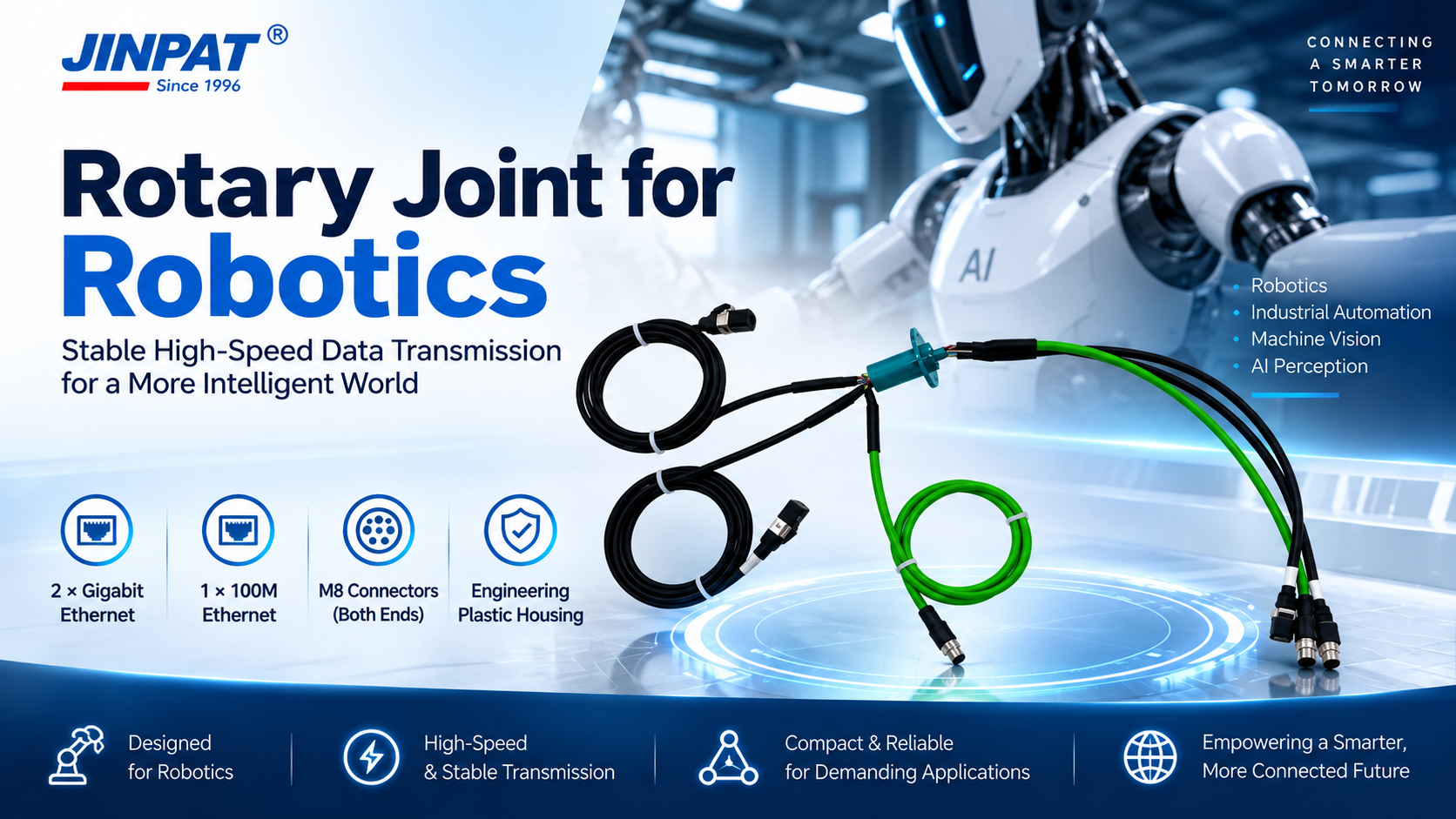
The JINPAT LPC-30-01E2-02E3 (JP48-123-002HW) provides a rotary transmission solution for this requirement.
Designed for Connected Automation Equipment
The LPC-30-01E2-02E3 supports:
2 Gigabit Ethernet channels
1 100M Ethernet channel
M8 connectors
Robotic and industrial automation applications
This makes it suitable for equipment where several network-connected devices are installed on rotating structures.
Supporting Smart Manufacturing
Vietnam's manufacturing sector includes electronics, machinery, automotive components and increasingly automated production environments.
As manufacturers introduce more robotics and automated inspection systems, industrial machines require faster and more reliable data communication.
A Gigabit Ethernet slip ring can connect rotating cameras, sensors and controllers to the stationary control system without relying on cables that would continuously twist during rotation.
Machine Vision and Automated Inspection
Machine vision is becoming particularly important in modern production.
Industrial cameras can inspect:
Product dimensions
Surface defects
Assembly accuracy
Packaging quality
Component positioning
If the inspection system rotates around the product, the camera may also rotate.
High-speed Ethernet transmission through the rotating interface allows image data to reach the processing system while maintaining the required mechanical movement.
Robotics
Robots are another important application.
A modern robotic system may include multiple Ethernet devices inside or around its rotating joints.
Two Gigabit Ethernet channels allow the LPC-30-01E2-02E3 to support high-bandwidth devices, while an additional 100M channel can support another network or control connection.
This gives automation engineers more flexibility when designing the robot's communication architecture.
Selecting a Slip Ring for Automated Machinery
When developing automated equipment, engineers should provide the following information:
Ethernet communication requirements
Number of Ethernet channels
Electrical circuits
Current and voltage
Rotational speed
Installation dimensions
Connector requirements
Working environment
JINPAT can use this information to recommend an appropriate slip ring or develop a customized configuration when necessary.
Connecting Rotation with Industry 4.0
Automation is no longer only about mechanical movement.
Modern machines depend on continuous communication.
The rotary interface therefore needs to support both motion and data connectivity.
With 2 × Gigabit Ethernet + 1 × 100M Ethernet and M8 connectors, the JINPAT LPC-30-01E2-02E3 is designed for robots, automated machinery and other intelligent rotating equipment.
Building automation equipment in Vietnam? Contact JINPAT to discuss your Ethernet slip ring requirements.