How to Select the Right Slip Ring for Automation Equipment: A Complete Engineering Guide
In the era of Automation 4.0, devices like robotic arms and rotary tables require continuous 360-degree rotation. To reliably transmit power and data between a stationary structure (stator) and a rotating structure (rotor), selecting the slip ring is critical to system lifespan and costly downtime.
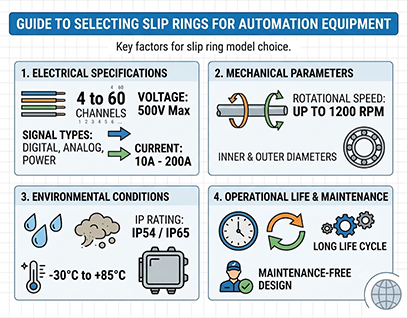
Here is a concise technical guide for engineers selecting industrial slip rings:
1. Electrical Specifications: The Foundation of Reliability
Choosing incorrect electrical parameters causes signal attenuation, data loss, or component burnout.
Number of Channels: Define the exact circuit counts required for power (high/low current) and dedicated signals.
Current & Voltage Ratings: Identify continuous current (Amps) and voltage (Volts) per channel. For servo applications, factor in peak startup currents.
Signal Compatibility: Modern machinery requires more than basic AC/DC power. Ensure ratings support high-speed protocols (Ethernet 1Gbps, Profibus, CANopen), PLC signals, or sensitive analog inputs (PT100 temperature sensors and thermocouples).
2. Mechanical Specifications & Form Factors
Installation space is premium real estate. Match the physical configuration to your structural limitations:
Through-Bore Slip Rings: Feature a hollow center (3mm to over 500mm) ideal for routing drive shafts, pneumatic lines, or hydraulic pipes.
Capsule Slip Rings: Compact and lightweight; perfect for space-constrained applications like miniature robotic joints or medical devices.
Pancake Slip Rings: Utilized when vertical/axial space is strictly limited, but ample horizontal/radial clearance exists.
3. Operational Speed and Lifespan (RPM)
Rotational Speed: Standard automation operates between 100 to 500 RPM. High-speed applications running at several thousand RPM require specialized brush designs to manage friction and heat dissipation.
Working Lifespan: Measured in millions of rotations, directly dictated by contact material choices and mechanical wear rates.
4. Environmental Factors & IP Ratings
Factory floors vary from pristine cleanrooms to hot, humid, or dusty environments:
Standard Environments: IP51 to IP54 protection is generally sufficient for cleanrooms and enclosed cabinets.
Harsh Environments: Food & Beverage washdowns, chemical processing, or outdoor setups require IP65 to IP68 ratings to block moisture, dust, and oil ingress.
Housing Material: Choose lightweight engineering plastics for light-duty roles. Opt for aluminum alloy or stainless steel for heavy-duty, anti-corrosion, and rugged industrial environments.
5. Contact Technology: Ensuring Signal Integrity
Transmission quality depends entirely on the brush-to-ring contact technology:
Gold-to-Gold Contacts: Offer the resistance, electrical noise, and exceptional signal integrity. This is the gold standard for high-speed data and low-current signals.
Silver/Copper Fiber Brushes: suited for heavy-duty power transmission where high current capacity and rugged durability are paramount.
Conclusion: Design for the Future
Investing time in selecting the right slip ring during the early design phase saves thousands of dollars in unexpected machine downtime later.
As a trusted provider of automation solutions, JINPAT Electronics offers a comprehensive portfolio of industrial slip rings—ranging from standard, off-the-shelf models to fully customized solutions engineered to fit your specific project requirements.
Contact our engineering team today for a detailed technical consultation and an optimized quote for your next automation project!