Q&A Special: Issues with the Rotating End of Your Coating Machine? You Might Need a JINPAT Slip Ring
Q1: Why do sensor signals often experience momentary spikes or dropouts when the equipment is rotating continuously?
A: This is primarily caused by fluctuations in dynamic contact resistance. Traditional contact materials tend to exhibit resistance fluctuations during high-speed rotation, leading to signal "packet loss." JINPAT core contact components utilize precious metal (silver-on-silver) materials, which feature extremely low contact resistance and stable performance. Even under continuous operation, resistance fluctuation is controlled within the milliohm range, ensuring rock-solid signal transmission stability.
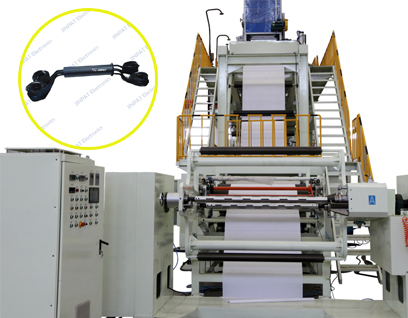
Q2: The coating rotation speed is extremely slow (approx. 20 RPM); standard slip rings often exhibit jerky motion or sticking. How does JINPAT resolve this?
A: Low-speed operating conditions impose stricter requirements on a slip ring's rotational torque characteristics. Standard slip rings are prone to "creeping" or physical vibration at low speeds. JINPAT through-hole slip rings cover a full speed range from 0 to 100 RPM. We have specifically optimized our internal contact pressure and self-lubrication processes for low-speed scenarios, thereby eliminating mechanical vibrations caused by uneven friction and ensuring silky-smooth rotation to facilitate uniform coating application.
Q3: Will placing high-voltage (heating) circuits and low-voltage signal channels together result in interference?
A: No. JINPAT supports multi-channel hybrid transmission. Internally, we employ rigorous physical shielding layers and electrical isolation designs. Even when a high-voltage, high-current circuit (up to 180A) shares a compact housing with precision control signals, we achieve zero interference. This "parallel strong and weak current" solution not only streamlines the structural design but also guarantees data integrity.
Q4: Installation space is extremely limited; is there a more space-efficient solution than traditional cable drag chains?
A: Traditional cable drag chains are bulky and occupy a significant amount of space. JINPAT hollow-shaft slip rings are designed with a primary focus on high-level integration. It mounts directly onto the rotating shaft, serving as a replacement for traditional rotary hoses and cable drag chain systems. This design reduces installation space by over 50%; beyond offering a compact footprint and streamlined cabling, it stands as one of the most space-efficient solutions currently available in the field of rotary transmission.
Expert Commentary:
The stability of coating equipment hinges on the robustness of the "nervous system" at its rotating interface. Through the application of silver contact technology and a long-life design, JINPAT has elevated the slip ring from a mere "consumable component" to a "durable asset," thereby empowering enterprises to achieve their production goals of low maintenance and high output.